
By: Vincent Metcalfe, President & CEO, Pecoy Copper Corp.
Updated September 2026
In This Article
Copper has become one of the world’s most strategically important commodities. Electricity grids, renewable power, electric vehicles, data centres, artificial intelligence, industrial infrastructure and defence systems all require significant amounts of copper. At the same time, existing mines are getting older, grades are declining in many districts and major new copper mines can require well over a decade to discover, permit, finance and build.
Where will the world’s next generation of copper supply come from?
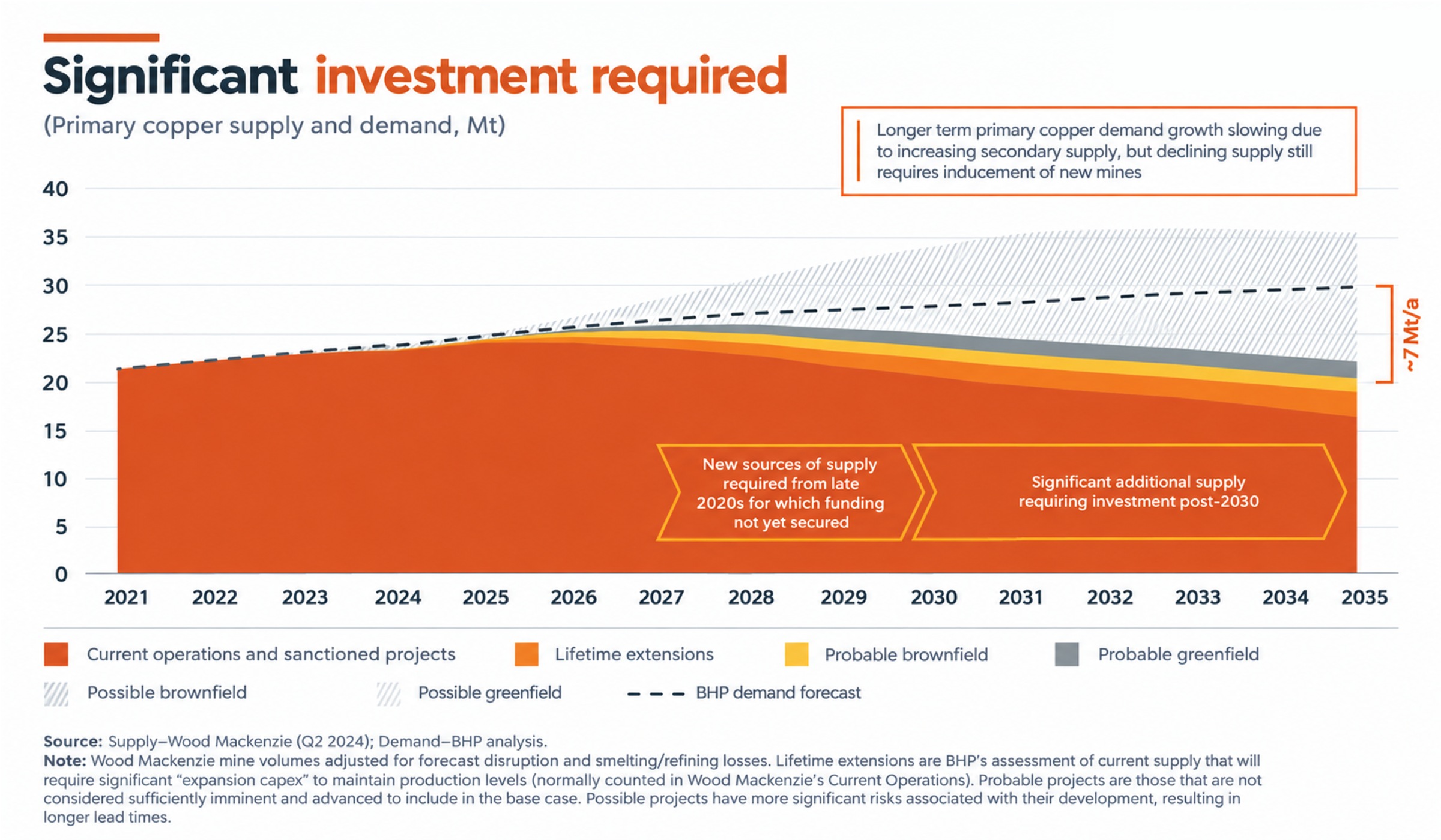
The International Energy Agency projects that, based on the current project pipeline, copper mine supply could fall approximately 25% short of primary supply requirements by 2035. The IEA also expects copper to record the largest absolute demand increase among the major critical minerals it tracks, adding about 7 million tonnes of demand to 2040.
S&P Global sees a similar long-term challenge. Its 2026 analysis projects global copper demand increasing from 28.3 million tonnes in 2025 to 42.4 million tonnes by 2040. Even after accounting for probable, possible and speculative projects, S&P estimates a potential annual supply gap of 10.1 million tonnes by 2040.
Those forecasts will inevitably change as prices, recycling, technology, substitution and new projects evolve. The central issue, however, remains: the copper industry needs more mines—and recent events have demonstrated how vulnerable existing supply can be.
Why Copper Supply Remains Vulnerable
Copper supply disruptions are not theoretical.
Cobre Panamá remains out of normal mining operation following its 2023 shutdown. In 2026, First Quantum began preparations to process previously mined stockpiled material, with 30,000–40,000 tonnes of copper expected from stockpiles during the year. That processing does not represent a restart of normal mining operations.
Grasberg in Indonesia is recovering from the September 2025 external mud-rush incident. Freeport-McMoRan said in July that overall production rates were expected to approximate 65% of normal capacity in the second half of 2026, 80% by mid-2027 and approach full capacity by the end of 2027.
Kamoa-Kakula in the Democratic Republic of Congo is also adapting its mine plans following operational, geotechnical and hydrological challenges. Ivanhoe Mines tightened 2026 copper-production guidance to 290,000–310,000 tonnes and is undertaking a 250,000-metre infill drilling program to improve geotechnical and hydrological modelling for an updated life-of-mine plan.
These are different events involving different mines. Together, however, they reinforce a simple point: even some of the world’s largest copper operations are vulnerable to unexpected interruptions. A healthy future copper market therefore requires not only expansions at existing mines, but a deep pipeline of new projects capable of becoming meaningful producers.
Copper M&A Is Sending Another Signal – A Shrinking Pool of Independent Copper Development Projects
There is another indication of how strategically important large copper-development projects are becoming. Mining companies are increasingly acquiring or backing development assets rather than relying exclusively on their own exploration pipelines. Three transactions in 2026 are particularly noteworthy.
Cascabel: SolGold / Jiangxi Copper
SolGold entered a new chapter following its acquisition by Jiangxi Copper, bringing the Cascabel copper-gold project in Ecuador under the control of a major global copper producer. Cascabel had already advanced through extensive resource definition and development studies before the ownership change.
Cactus: Arizona Sonoran / Hudbay
Hudbay Minerals completed its acquisition of Arizona Sonoran Copper Company on June 24, 2026, obtaining 100% ownership of the Cactus Project in Arizona. Hudbay is advancing Cactus alongside Copper World as part of a larger U.S. copper-growth strategy.
Cañariaco: Alta Copper / Fortescue
Fortescue completed its acquisition of Alta Copper and its Cañariaco Project in northern Peru in 2026. Fortescue has explicitly linked the transaction to its strategy to increase exposure to copper as a critical material for electrification and decarbonisation.
Why these transactions matter. Cascabel, Cactus and Cañariaco have not disappeared from the future copper-supply pipeline. They have moved from independent developers into larger mining groups. As strategic buyers acquire significant development assets, the universe of sizeable independent copper projects available to public-market investors and potential industry partners becomes smaller.
Copper demand is expected to grow materially; major operating mines have experienced significant disruptions; recent M&A shows strategic buyers are moving earlier in the development cycle; and a relatively limited group of large independent copper projects remains available to advance toward production.
How We Selected the 10 Projects
There is no single objective definition of the “best” copper-development project. Projects differ materially in size, grade, metallurgy, jurisdiction, capital requirements, permitting, infrastructure and development stage. For this watchlist, we looked for a combination of:
- Scale and contained-metal potential
- Credible technical or development progression
- Infrastructure and location advantages
- Strategic validation or financing support
- Resource-growth or district-scale upside
- A realistic pathway toward further de-risking and, ultimately, development
This is an editorial watchlist, not an investment ranking. Pecoy is listed first because Pecoy Copper is the publisher of this article. The remaining projects are presented as a peer set rather than ranked from best to worst.
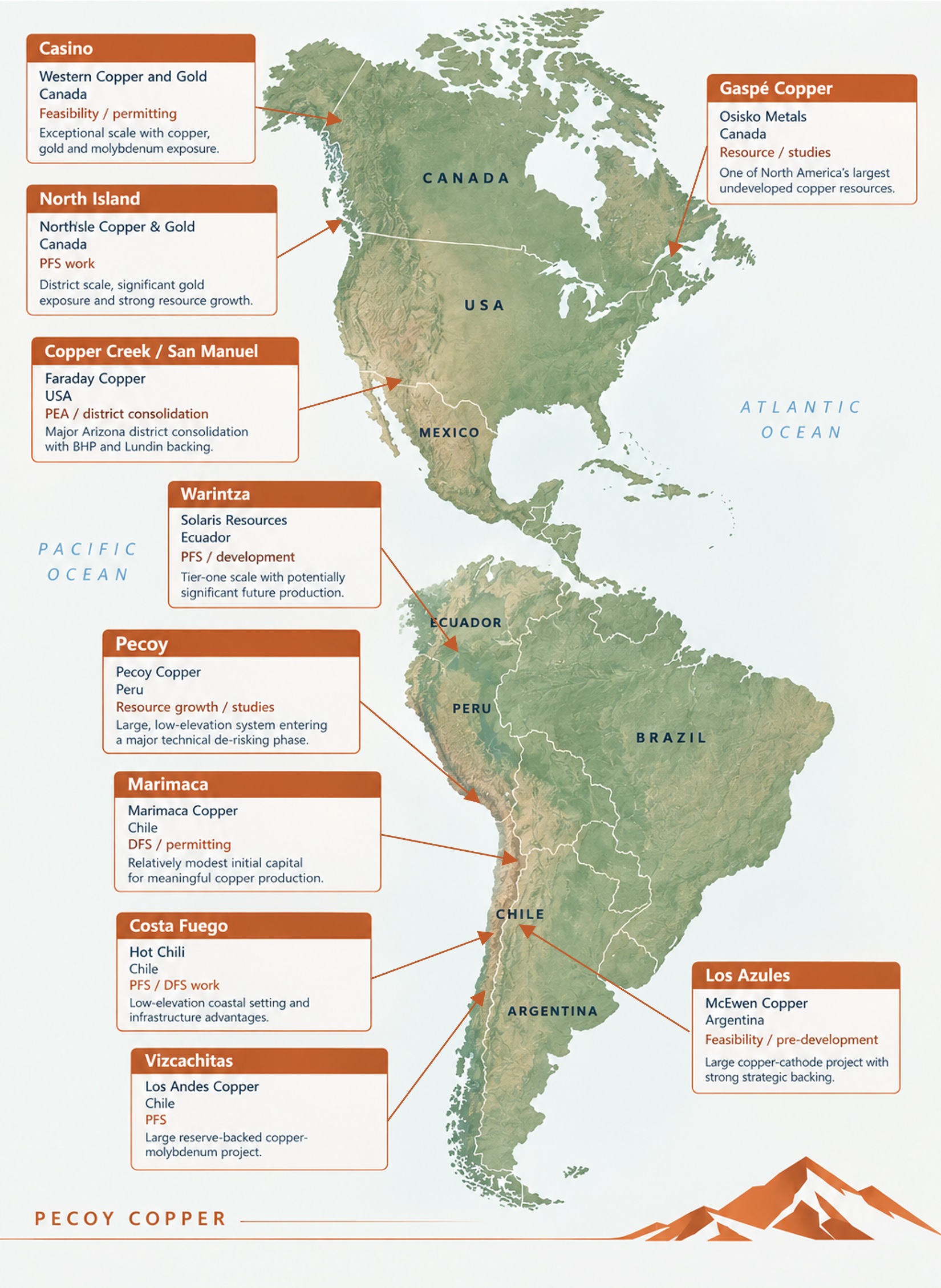
10 Copper Development Projects to Watch in 2026
| Project | Company | Location | Stage | Why it stands out |
|---|---|---|---|---|
| Pecoy | Pecoy Copper | Peru | Resource growth / studies | Large, low-elevation system entering a major technical de-risking phase |
| Warintza | Solaris Resources | Ecuador | PFS / development | Tier-one scale with potentially significant future production |
| Los Azules | McEwen Copper | Argentina | Feasibility / pre-development | Large copper-cathode project with strong strategic backing |
| Vizcachitas | Los Andes Copper | Chile | PFS | Large reserve-backed copper-molybdenum project |
| Costa Fuego | Hot Chili | Chile | PFS / DFS work | Low-elevation coastal setting and infrastructure advantages |
| Marimaca | Marimaca Copper | Chile | DFS / permitting | Relatively modest initial capital for meaningful copper production |
| Copper Creek / San Manuel | Faraday Copper | USA | PEA / district consolidation | Major Arizona district consolidation with BHP and Lundin backing |
| Gaspé Copper | Osisko Metals | Canada | Resource / studies | One of North America’s largest undeveloped copper resources |
| North Island | NorthIsle Copper & Gold | Canada | PFS work | District scale, significant gold exposure and strong resource growth |
| Casino | Western Copper and Gold | Canada | Feasibility / permitting | Exceptional scale with copper, gold and molybdenum exposure |
1. Pecoy — Pecoy Copper | Peru
Why it stands out: Large scale, low elevation and an important transition toward technical de-risking.
The 100%-owned Pecoy Project is a large copper-gold-molybdenum-silver porphyry system in southern Peru’s Coastal Copper Belt. Pecoy currently hosts an Inferred Mineral Resource of 865 million tonnes grading 0.34% copper, together with molybdenum, gold and silver, containing approximately 6.45 billion pounds of copper.
One of Pecoy’s distinguishing characteristics is its location. At approximately 1,650 metres elevation, the project sits substantially lower than many major Andean copper developments and benefits from year-round access and proximity to highway, grid-power, labour and port infrastructure.
From Resource Expansion to Development Studies
Pecoy Copper is undertaking an extensive 2026 exploration program of up to 40,000 metres across Pecoy and Tororume, focused on expanding the mineralized system, testing higher-grade areas and assessing additional targets.
Recent drilling at South Breccia has demonstrated the potential scale of the system. Hole PEC-25-066 intersected 1,020.5 metres grading 0.43% Cu and 0.09 g/t Au from 48 metres. The hole extended mineralization approximately 306 metres below the current resource pit shell and ended in mineralization.
Exploration, however, is only one component of the project’s next phase. As drilling progresses, Pecoy intends to move aggressively toward the next stage of technical and economic evaluation, subject to ongoing results, technical evaluation, required approvals and available funding.
That transition represents a major de-risking stage. A mineral resource establishes geological scale. Development studies begin answering the questions that determine how—or whether—that resource can ultimately become an economically viable mine: mining method, production rate, metallurgy, recoveries, geotechnical conditions, water, infrastructure, environmental requirements, capital intensity and project economics.
Pecoy has already begun advancing several of these workstreams, including metallurgical optimization, geological modelling, environmental baseline work and permitting activities. As the dataset grows, these workstreams are expected to increasingly inform the pathway toward broader technical and economic studies.
Why you should be watching it: Pecoy combines an already substantial resource with exploration upside, favourable elevation and infrastructure characteristics, while increasingly moving from pure resource expansion toward the technical work required to systematically de-risk a major copper development.
2. Warintza — Solaris Resources | Ecuador
Why it stands out: Tier-one scale and production potential.
Warintza is one of the largest copper projects still being advanced by an independent developer. Solaris reports more than 3.7 billion tonnes of Measured and Indicated Resources, 2.1 billion tonnes of Inferred Resources and 1.3 billion tonnes of Mineral Reserves.
The project’s prefeasibility work outlines average copper-equivalent production of more than 300,000 tonnes annually during the first five years and more than 240,000 tonnes annually over the first 15 years, with a reserve life exceeding 20 years.
Why we are watching it: Very few independent copper developers control projects capable of potentially producing more than 300,000 tonnes of copper equivalent annually during their initial years.
3. Los Azules — McEwen Copper | Argentina
Why it stands out: A large, advanced copper-cathode development with substantial strategic backing.
Los Azules is located in San Juan Province and has progressed into one of the more advanced large-scale copper developments in the Americas. Its 2025 Feasibility Study outlines a 21-year mine life and average annual copper cathode production of approximately 148,200 tonnes.
The development concept uses heap leaching and solvent extraction-electrowinning to produce LME Grade A copper cathode on site rather than relying on a conventional concentrator and tailings facility.
Why we are watching it: Los Azules combines meaningful scale, advanced engineering, strategic shareholders and a development concept capable of producing finished copper cathode.
4. Vizcachitas — Los Andes Copper | Chile
Why it stands out: Large reserve-backed scale in one of the world’s premier copper jurisdictions.
Vizcachitas is a large copper-molybdenum porphyry project in central Chile. Los Andes Copper reports approximately 1.2 billion tonnes of Mineral Reserves at 0.41% CuEq, together with 1.54 billion tonnes of Measured and Indicated Resources.
Its prefeasibility study contemplates average annual copper production of more than 183,000 tonnes during the first eight years and more than 152,000 tonnes over the 26-year mine life.
Why we are watching it: Vizcachitas combines scale, defined reserves and meaningful projected production within Chile’s established copper-mining industry.
5. Costa Fuego — Hot Chili | Chile
Why it stands out: Low elevation, coastal infrastructure and a meaningful production profile.
Costa Fuego is a copper-gold development in Chile’s coastal range. Hot Chili’s 2025 prefeasibility study outlines a 20-year processing life and average annual production during the first 14 years of approximately 95,000 tonnes of copper and 48,000 ounces of gold, plus silver and molybdenum.
The project is relatively close to Pacific port infrastructure, while Hot Chili has also been advancing a broader water strategy to support project development.
Why we are watching it: Infrastructure and water can become major constraints for large Andean projects. Costa Fuego’s coastal location and water strategy provide important differentiators.
6. Marimaca — Marimaca Copper | Chile
Why it stands out: Comparatively manageable initial capital and a relatively straightforward development concept.
Marimaca differs from many major porphyry developments because its development strategy is centred on oxide copper mineralization and conventional heap-leach/SX-EW processing. The 2025 Definitive Feasibility Study outlines approximately US$587 million of pre-production capital for nominal 50,000-tonne-per-year copper cathode production capacity and an estimated 13-year reserve life.
Why we are watching it: In an industry where capital intensity can determine whether a deposit actually becomes a mine, Marimaca’s comparatively manageable development scale is notable.
7. Copper Creek / San Manuel — Faraday Copper | Arizona, United States
Why it stands out: The potential consolidation of a major historic U.S. copper district with BHP and Lundin support.
Copper Creek is a porphyry and breccia-hosted copper project in Arizona with more than 320 identified breccias, less than 15% of which have historically been drill tested. In July 2026, Faraday announced definitive agreements with BHP involving the adjacent San Manuel property, subject to transaction closing conditions.
If completed as announced, the transaction would materially expand Faraday’s Arizona district position and bring BHP in as a major shareholder, alongside strategic support from the Lundin Group.
Why we are watching it: This is more than a single-resource story. It is a district-consolidation thesis involving land, infrastructure, exploration upside and strategic validation from major mining groups.
8. Gaspé Copper — Osisko Metals | Québec, Canada
Why it stands out: Exceptional scale in an established Canadian mining district.
Gaspé Copper emerged as a major North American development story following Osisko Metals’ April 2026 resource update. The project contains approximately 1.834 billion tonnes of Measured and Indicated Resources grading 0.27% copper, containing approximately 10.8 billion pounds of copper, together with 239 million tonnes of Inferred Resources grading 0.41% copper.
The project surrounds the historic Gaspé Copper mining complex near Murdochville, Québec, providing a brownfield setting in an established mining jurisdiction.
Why we are watching it: Few independent North American developers control an undeveloped copper resource approaching this scale, particularly in a brownfield Canadian setting.
9. North Island Project — NorthIsle Copper & Gold | British Columbia, Canada
Why it stands out: District-scale copper-gold exposure with rapidly increasing resources.
North Island Project extends across a large mineralized belt on northern Vancouver Island. In August 2026, NorthIsle published an integrated resource incorporating Hushamu, Red Dog, Northwest Expo and West Goodspeed.
The 2026 resource contains approximately 1.2 billion tonnes of Indicated Resources with total contained metal of 10.1 billion pounds of copper equivalent, together with additional Inferred Resources. NorthIsle said the update will underpin a Pre-Feasibility Study targeted for Q1 2027.
Why we are watching it: North Island combines a substantial resource, meaningful gold and critical-mineral exposure, infrastructure advantages and district-scale exploration potential in British Columbia.
10. Casino — Western Copper and Gold | Yukon, Canada
Why it stands out: Exceptional scale and exposure to several valuable metals.
Casino is one of Canada’s largest advanced copper-gold developments. Its 2022 Feasibility Study outlines a 27-year mine life and average annual production of approximately 164 million pounds of copper, 259,000 ounces of gold and 15 million pounds of molybdenum, plus silver.
Casino is advancing through environmental assessment and has attracted strategic support from major mining groups including Rio Tinto and Mitsubishi Materials.
Why we are watching it: Casino combines very large scale, a long mine life and meaningful exposure to copper, gold and molybdenum within a single project.
The challenge is not simply discovering more copper. It is turning high-quality copper resources into the mines the world will eventually require.
From Discovery to Development: Why De-Risking Matters
The projects above are at different points on the development curve. That distinction is critical. A typical major copper project progresses broadly through:
Exploration → Resource Definition → Metallurgy → Preliminary Economic Studies → Pre-Feasibility → Feasibility → Permitting → Financing → Construction
At every stage, new information reduces—or occasionally identifies—risk. For a large porphyry deposit, relatively small changes in assumptions surrounding recoveries, throughput, strip ratio, water, infrastructure, capital cost or operating cost can have substantial implications for project economics.
That is why technical studies represent considerably more than simply producing another report. They are the process through which geological potential begins to become a defined development project.
This is particularly relevant for Pecoy. The current exploration program is designed to continue testing the scale and higher-grade potential of the system. At the same time, advancing metallurgy, environmental work, geological modelling and broader technical and economic studies is expected to increasingly focus on determining how that geological scale could translate into a potential future mining operation.
For Pecoy, this next de-risking phase is expected to be one of the most important stages in moving the project forward.
Frequently Asked Questions
Is the world facing a copper shortage?
Several long-term forecasts indicate that future copper demand could exceed mine supply from currently operating and announced projects. The IEA projects an approximately 25% supply gap by 2035 under its base-case project pipeline, while S&P Global estimates that global copper demand could reach 42.4 million tonnes by 2040 and potentially exceed supply by roughly 10.1 million tonnes annually without a substantial supply response. These projections are not certainties; higher prices, recycling, substitution, technology and new projects can change the balance.
Why is copper demand increasing?
Copper is required across electrical infrastructure, power grids, renewable generation, electric vehicles, industrial equipment, construction and traditional economic activity. Expanding data-centre and artificial-intelligence infrastructure is also contributing to electricity and copper demand.
What are some of the largest copper supply disruptions?
Recent examples include the continued absence of normal mine production at Cobre Panamá, the recovery of Grasberg following its September 2025 mud-rush incident, and operational and mine-plan challenges affecting Kamoa-Kakula.
What are the top copper development projects to watch in 2026?
This article highlights Pecoy, Warintza, Los Azules, Vizcachitas, Costa Fuego, Marimaca, Copper Creek / San Manuel, Gaspé Copper, North Island and Casino. They are at different stages and should not be interpreted as a numerical investment ranking.
Where is the Pecoy Copper Project?
Pecoy is located in southern Peru within the country’s major copper belt. The project is situated at approximately 1,650 metres elevation and currently hosts an Inferred Mineral Resource of 865 million tonnes grading 0.34% copper, together with molybdenum, gold and silver.
What is the next stage for Pecoy Copper?
Pecoy continues an extensive exploration and drilling program aimed at testing the scale, continuity and higher-grade potential of the mineralized system. As that work progresses, the Company intends to increasingly advance technical and economic studies and related de-risking activities, subject to exploration results, technical evaluation, required approvals and available funding.
Editorial Disclosure
Pecoy Copper Corp. is the publisher of this article and owns a 100% interest in the Pecoy Project.
The projects discussed were selected for informational and educational purposes based on publicly available information and do not constitute an investment ranking or investment recommendation. Project economics, Mineral Resources, Mineral Reserves and forward-looking information regarding third-party projects are based on information reported by the applicable project owners and may have been prepared using different assumptions, commodity prices, cut-off grades, currencies, effective dates and methodologies and therefore should not be considered directly comparable.
Mineral Resources that are not Mineral Reserves do not have demonstrated economic viability. Forward-looking statements regarding Pecoy Copper’s future activities are subject to risks, uncertainties, technical evaluation, required approvals, available funding and other factors. Technical disclosure relating to Pecoy should be read together with Pecoy Copper’s applicable NI 43-101 technical reports and Qualified Person disclosure.
Legal Reference & Sources
Primary Source Links Used for Fact-Checking
- IEA — Global Critical Minerals Outlook 2026
- S&P Global — The Copper Conundrum (2026)
- First Quantum — Q1 2026 / Cobre Panamá stockpile processing
- Freeport — Q2 2026 / Grasberg recovery
- Ivanhoe Mines — Q2 2026 / Kamoa-Kakula
- Pecoy Copper — Pecoy Project
- Solaris Resources — Warintza
- McEwen Copper — Los Azules
- Los Andes Copper — Vizcachitas
- Hot Chili — Costa Fuego
- Marimaca Copper — Marimaca Project
- Faraday Copper — Copper Creek
- Osisko Metals — Gaspé Copper 2026 MRE
- NorthIsle — North Island Project
- NorthIsle — August 2026 resource update
- Western Copper and Gold — Casino Project
- Hudbay — Arizona Sonoran acquisition completion
- Fortescue — Alta Copper / Cañariaco
- SolGold — current Cascabel / Jiangxi ownership